📑 Table of Contents
1. What Really Happens to a Frame at 35 LBS String Tension
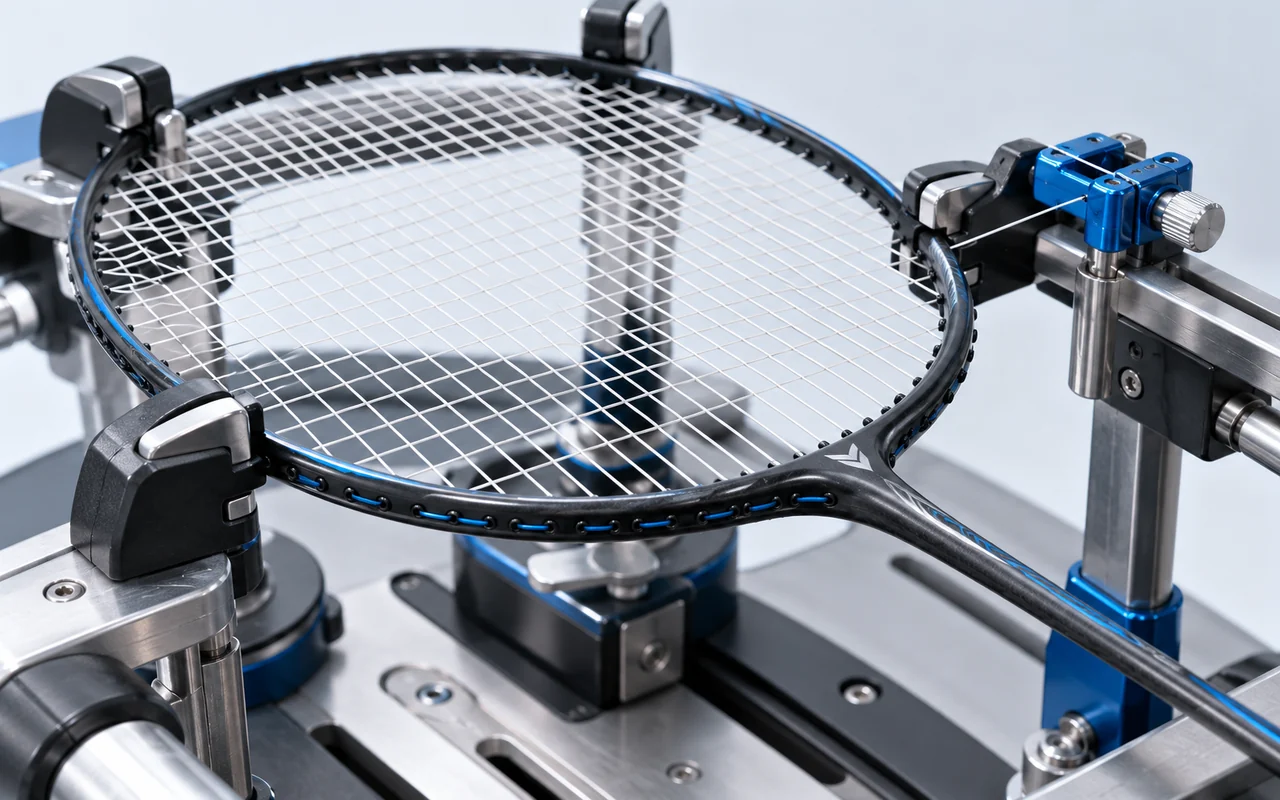
When a badminton racket is strung at 30 to 35 LBS (approximately 13.6 to 15.8 kgf) across 72 to 76 grommet holes, the cumulative inward compressive load exerted on the carbon hoop exceeds 280 kilograms! At this extreme load, poorly bonded carbon layers suffer micro-delamination, causing frame distortion or instant fracture during stringing.
2. High-Pressure Foam Core Molding vs Bladder Blow-Up
Traditional cheap rackets rely solely on nylon air bladders that inflate inside the mold. For our 30+ LBS certified professional line, RacketOEM deploys Solid High-Density PMI Structural Foam Core molding. The foam expands uniformly under 160°C heat, compressing the carbon prepreg firmly against the steel cavity from the inside out, eliminating resin voids and microscopic air bubbles.
3. Reinforcement at the 12, 3/9, and T-Joint Stress Points
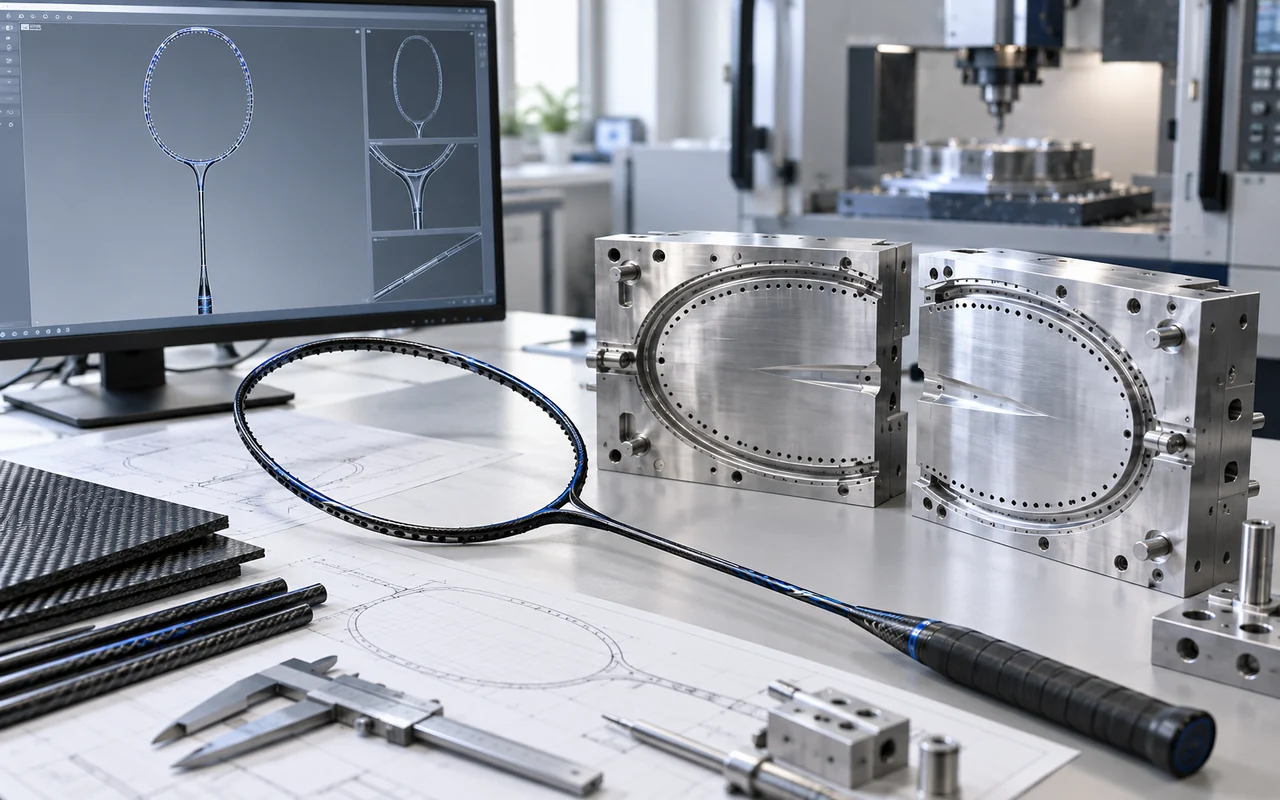
Our stress-strain finite element analysis (FEA) highlights three vulnerable zones on the hoop: the 12 o'clock apex (susceptible to pull-in buckling), the 2/10 o'clock corners, and the T-joint junction. We apply localized 4-layer 30T/40T carbon reinforcement patches at these zones to distribute point tension smoothly throughout the perimeter.
4. Grommet Groove Depth & High-Durometer Nylon 66
High tension can cause thin strings to bite into the frame edge (grommet sinking). We deepen the perimeter string groove and install custom high-grade Nylon 66 grommets with reinforced flare collars to prevent string pressure from fracturing the composite wall.
Multi-Sport Racket OEM Manufacturing Matrix (39 Active Platforms)
Manufactured at our 12,000 m² Hangzhou Fuyang facility (Hangzhou Bailian Trading Co., Ltd.), our 39 OEM racket platforms span four court sports—Badminton (15 models), Padel (14 models), Tennis (4 models), and Squash (6 models)—engineered across Full Carbon, Carbon Composite, Aluminum Alloy, and Steel constructions.
| Sport Category | Active Models | Material & Layup Systems | Core Physical & Structural Parameters | Representative Model Codes |
|---|---|---|---|---|
| Badminton racket | 15 | 24T/30T/40T Toray Full Carbon (FC), Carbon Composite (CC), Aluminum Alloy (AL), Steel (ST) | Weight 3U/4U/5U (75g–98g); Balance 285–305mm; Shaft Ø 6.8–7.0mm; Tension 20–35 LBS | FC-BD-01, FC-BD-02, FC-BD-03, CC-BD-01, AL-BD-01, ST-BD-01 |
| Padel racket | 14 | 3K / 12K / 18K Woven Full Carbon (FC) & Carbon/Fiberglass Composite (CC) + EVA Memory Core | Profile 38mm standard; Weight 360±10g; Length 455mm; Balance 260–270mm; EVA Hardness 13°–17° | FC-PD-01, CC-PD-01, CC-PD-02, CC-PD-04, CC-PD-08, CC-PD-13 |
| Tennis racket | 4 | T700 Full Carbon Monocoque (FC), Carbon Composite (CC), Aluminum Alloy (AL), Steel (ST) | Head Size 96–105 sq.in.; String Pattern 16×19; Tension 52–62 LBS; Length 685mm (27 in) | UN-TN-01, UN-TN-02, UN-TN-03, UN-TN-04 |
| Squash racket | 6 | High-Modulus Full Carbon (FC), Carbon Composite (CC), Lightweight Aluminum (AL), Steel (ST) | Head Size 72.5–77.5 sq.in. (500 cm²); String Pattern 14×18 / 16×17 / 16×19; Length 685mm | UN-SQ-01, UN-SQ-02, UN-SQ-03, UN-SQ-04, UN-SQ-05, UN-SQ-06 |
Frequently Asked Sourcing & Engineering Questions
Do all carbon rackets labeled "35 LBS" actually support it safely?
Unfortunately, many low-end producers print "35 LBS" as marketing hype, leading to warranty returns. RacketOEM conducts hydraulic stringing machine stress tests on 100% of our production batch samples up to 38 LBS safety margin.
What is the recommended warranty string tension for a commercial brand?
We recommend advertising 28–30 LBS on mid-range retail lines and 32–34 LBS on high-end pro models, preserving a comfortable buffer against aggressive stringing mistakes.