📑 Table of Contents
1. Traditional Box Frame: Maximum Power & High-Tension Support
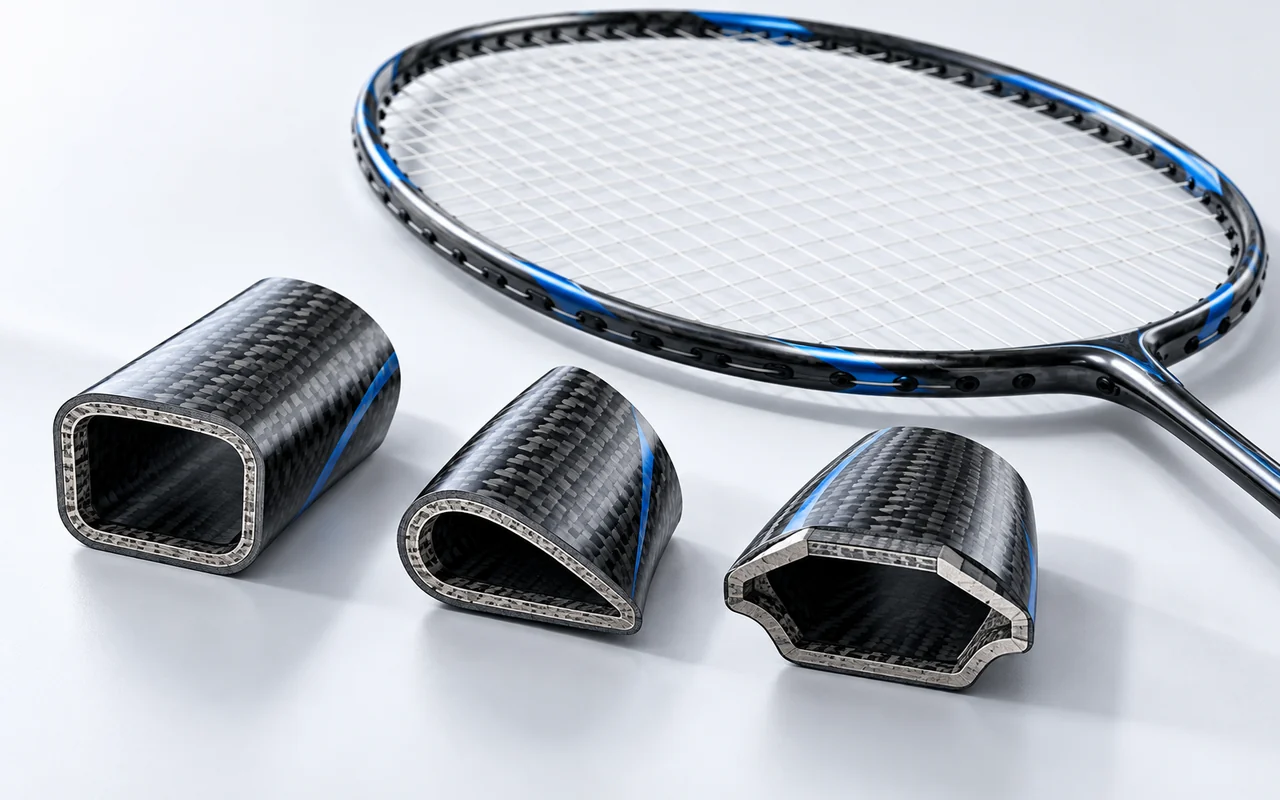
The Box Frame features a rectangular cross-section. Its primary advantage is massive structural section modulus: it resists lateral deformation and delivers crisp, direct kinetic feedback upon impact. Box frames are capable of supporting 32–35 LBS string tensions with zero warping, making them the preferred choice for heavy singles smashes and rear-court doubles players.
2. Aero / Sword Frame: Razor Wind Slicing Speed
The Aero Frame employs an airfoil or knife-edge cross section that cuts through airflow with minimal vortex turbulence. Wind tunnel tests indicate an 8% to 14% reduction in aerodynamic drag compared to standard box profiles. This accelerates swing speed for rapid net interception and defensive blocks, making it a favorite among doubles specialists.
3. Aero-Box Hybrid: The 2026 Competitive Standard
Our most requested OEM frame mold is the Dual-Optimum Hybrid: the upper third of the hoop (10 to 2 o'clock) features a streamlined aero blade profile to accelerate swing tempo, while the lower frame and T-joint transition to an enlarged box cross-section to maintain torsional rigidity and power transfer.
4. Isometric vs Oval Head Geometry
Over 98% of modern tournament rackets utilize an Isometric Head Shape, which squares the frame apex to equalize main and cross string lengths, expanding the effective sweet spot area by roughly 32% compared to classic oval frames.
Multi-Sport Racket OEM Manufacturing Matrix (39 Active Platforms)
Manufactured at our 12,000 m² Hangzhou Fuyang facility (Hangzhou Bailian Trading Co., Ltd.), our 39 OEM racket platforms span four court sports—Badminton (15 models), Padel (14 models), Tennis (4 models), and Squash (6 models)—engineered across Full Carbon, Carbon Composite, Aluminum Alloy, and Steel constructions.
| Sport Category | Active Models | Material & Layup Systems | Core Physical & Structural Parameters | Representative Model Codes |
|---|---|---|---|---|
| Badminton racket | 15 | 24T/30T/40T Toray Full Carbon (FC), Carbon Composite (CC), Aluminum Alloy (AL), Steel (ST) | Weight 3U/4U/5U (75g–98g); Balance 285–305mm; Shaft Ø 6.8–7.0mm; Tension 20–35 LBS | FC-BD-01, FC-BD-02, FC-BD-03, CC-BD-01, AL-BD-01, ST-BD-01 |
| Padel racket | 14 | 3K / 12K / 18K Woven Full Carbon (FC) & Carbon/Fiberglass Composite (CC) + EVA Memory Core | Profile 38mm standard; Weight 360±10g; Length 455mm; Balance 260–270mm; EVA Hardness 13°–17° | FC-PD-01, CC-PD-01, CC-PD-02, CC-PD-04, CC-PD-08, CC-PD-13 |
| Tennis racket | 4 | T700 Full Carbon Monocoque (FC), Carbon Composite (CC), Aluminum Alloy (AL), Steel (ST) | Head Size 96–105 sq.in.; String Pattern 16×19; Tension 52–62 LBS; Length 685mm (27 in) | UN-TN-01, UN-TN-02, UN-TN-03, UN-TN-04 |
| Squash racket | 6 | High-Modulus Full Carbon (FC), Carbon Composite (CC), Lightweight Aluminum (AL), Steel (ST) | Head Size 72.5–77.5 sq.in. (500 cm²); String Pattern 14×18 / 16×17 / 16×19; Length 685mm | UN-SQ-01, UN-SQ-02, UN-SQ-03, UN-SQ-04, UN-SQ-05, UN-SQ-06 |
Frequently Asked Sourcing & Engineering Questions
Does an Aero frame sacrifice smash power?
Slightly in pure ball-pocketing mass feel, but it compensates with higher swing head speed. For players with rapid acceleration, an Aero frame often yields equal or higher smash velocity.
Can RacketOEM develop a proprietary frame profile mold?
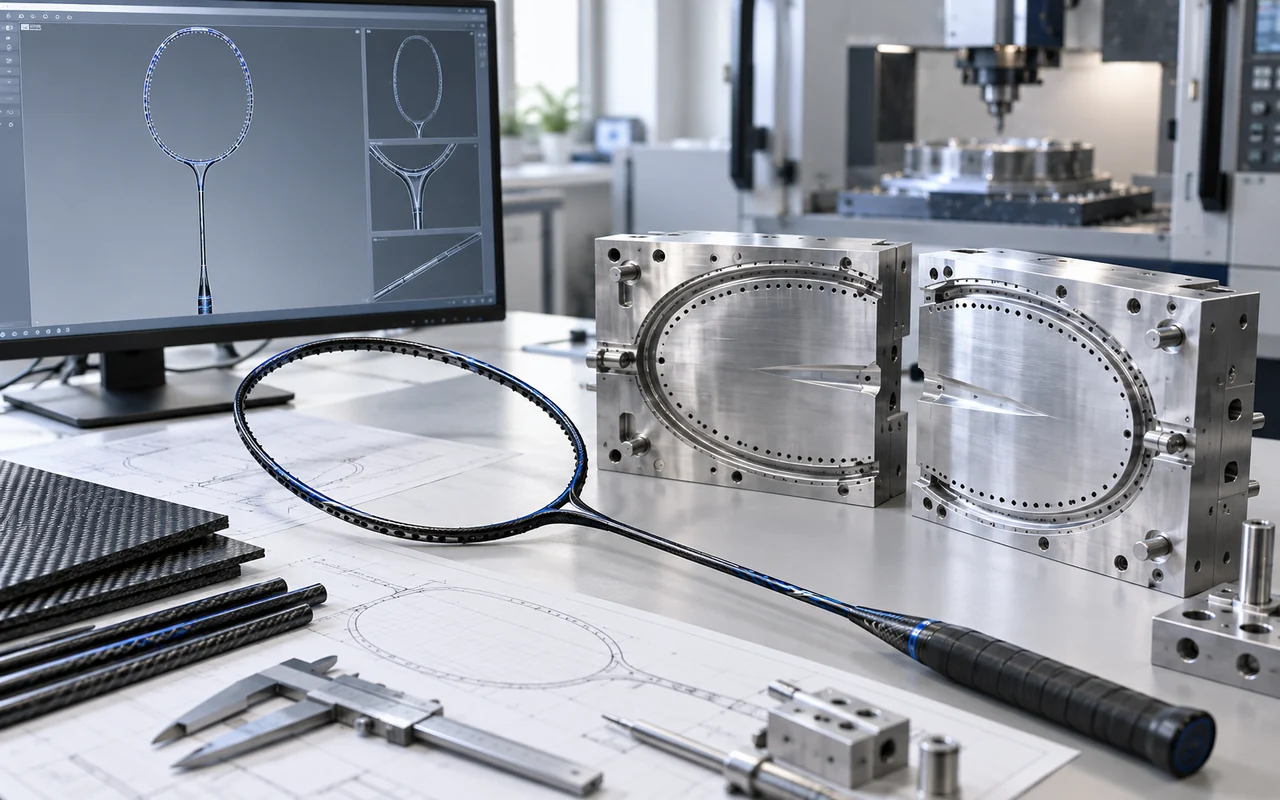
Yes. Our CAD designers can generate 3D STEP models and deliver 3D-printed SLA functional prototypes within 5 business days before CNC mold cutting.