📑 Table of Contents
- →1. Thermal Touch & 12 O'Clock Crown Groove Tests: Spotting Alloy Heads in Seconds
- →2. Built-In Carbon T-Joint vs. External Metallic T-Piece & Torsional Flex Test
- →3. Unstrung Static Weight (78–115g), Balance Point & Handle Counterweight Audit
- →4. Tension & Fatigue Lab Benchmark Table + B2B Channel Procurement Guide
1. Thermal Touch & 12 O'Clock Crown Groove Tests: Spotting Alloy Heads in Seconds
Separating a true 100% high-modulus full-carbon graphite frame (78–86g, 26–35 LBS) from an electrostatic-painted carbon-aluminum two-piece racket (90–95g, 20–22 LBS) takes less than 15 seconds without scraping paint or removing grommets. As an ISO-audited graphite badminton racket manufacturer and OEM badminton racket manufacturer operating a 12,000 m² facility in Hangzhou Fuyang, partnering directly with a Racket OEM Source Factory eliminates middleman material mislabeling through five non-destructive incoming quality checks before stringing or container loading.
Key Takeaways for B2B Racket Buyers & QC Inspectors:
- Test 1 — Frame Thermal Conductivity (205 vs ~1.5 W/m·K): Extruded 6061 aluminum hoops (CA-BD-01, AL-BD-01) draw warmth from skin rapidly and feel distinctly cold for 3–5 seconds at 20°C room temperature, whereas cured Toray epoxy-carbon frames (FC-BD-01–04) feel thermally neutral on contact.
- Test 2 — 12 O'Clock Crown String-Channel Geometry: Air-bladder hot-pressed carbon frames mold a crisp recessed trapezoidal string channel (1.4–1.8mm deep) that seats grommets flush; cold-bent aluminum profiles exhibit a shallow semicircular arc groove (0.6–0.9mm).
- Test 3 — Internal Carbon T-Joint vs. External T-Piece: Tournament full-carbon frames fuse hoop and shaft internally via a molded high-modulus carbon T-joint (≤3.5° torque deflection), while alloy and steel frames use external crimped T-pieces or bonded sleeves (>6.5°–10° twist).
- Tests 4 & 5 — Static Weight (78–86g vs 90–115g) & Tension Limits: 0.1g digital scale and fulcrum checks expose head-heavy alloy rims (>302mm balance) before a 28 LBS electronic stringing pull collapses an underrated retail frame.
Inspection Method 1: Frame Thermal Conductivity Touch Test
Many mass-market carbon vs aluminum badminton racket disputes stem from two-piece "half-carbon" constructions that bond a genuine graphite shaft to a painted aluminum head and print generic "Graphite Series" graphics on the tube. Condition the sample indoors at 18°C–22°C for 10 minutes, then press the bare hoop and shaft simultaneously against your inner wrist. Because aluminum conducts heat over 100× faster than cured epoxy-carbon prepreg, the alloy rim of CA-BD-01 (Carbon-Aluminum Two-Piece) feels unmistakably cool while its carbon shaft feels neutral; by contrast, both the 30T frame and 40T shaft of FC-BD-01 (100% Full Carbon) maintain identical skin-neutral warmth.
Inspection Method 2: 12 O'Clock Crown String-Channel Geometry
Examine the outer perimeter between 10 o'clock and 2 o'clock where strings bridge adjacent grommets. During 155°C steel-mold curing under 8–12 bar internal nylon bladder pressure, full-carbon prepreg expands into precision mold ribs to form an angular, flat-bottomed recessed trapezoidal channel. This countersinks grommet collars below the rim profile so court-floor scrapes do not sever strings. Conversely, rolled aluminum hoops (CA-BD-01, AL-BD-01) and tempered steel hoops (ST-BD-01) are formed on circular bending dies, producing a shallow concave arc groove with rounded shoulders.
2. Built-In Carbon T-Joint vs. External Metallic T-Piece & Torsional Flex Test
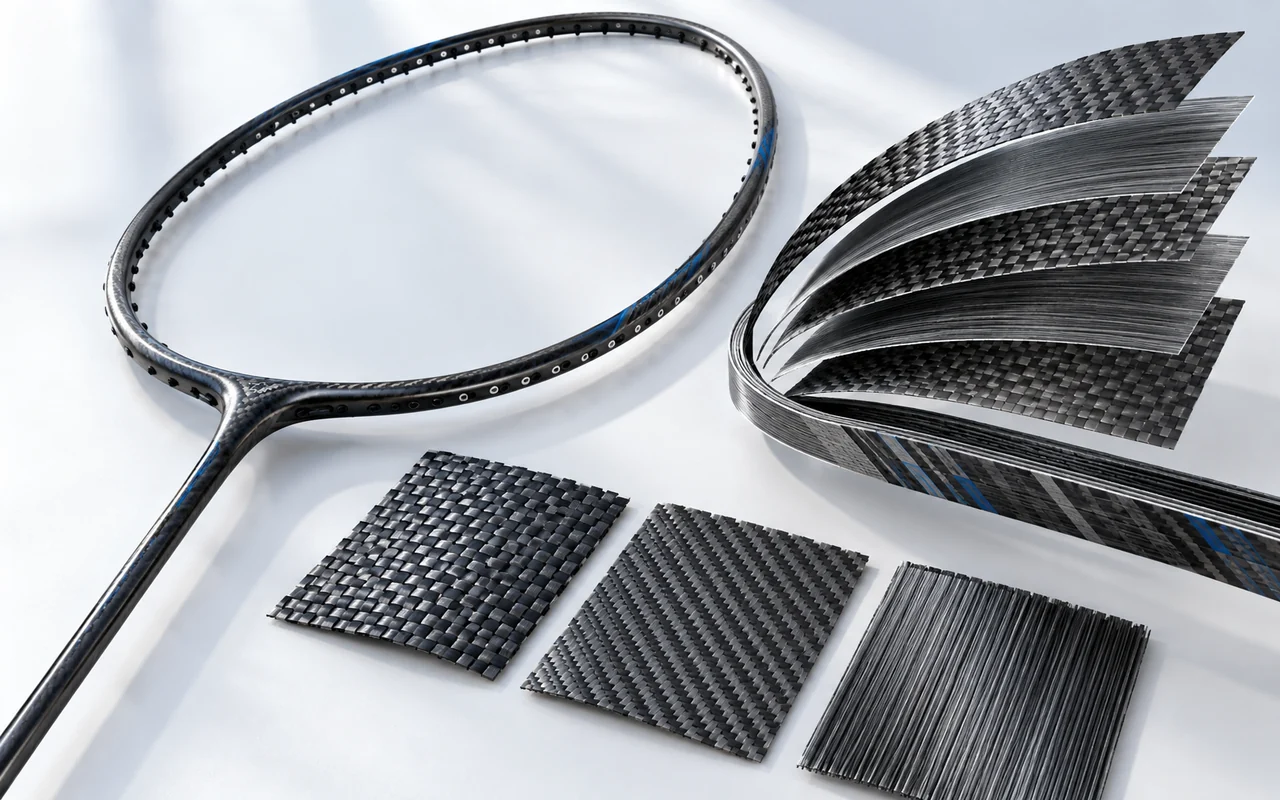
A common misconception among new buyers is that authentic full-carbon rackets are molded as a single hollow jointless tube. In reality, jointless molding compromises torsional stiffness and weight consistency; top OEM factories cure the carbon hoop and mandrel-rolled shaft separately, then unite them inside a secondary heated die using an internal Built-In Carbon T-Joint wrapped in ±45° bias carbon plies.
- Throat Seam & Magnet Check (Method 3A): Full-carbon (FC-BD-01–04) and carbon-composite (CC-BD-01) throats transition seamlessly with zero step-down collars. Full aluminum (AL-BD-01) and steel (ST-BD-01) rackets reveal an external stamped metallic T-piece with mechanical crimps at the 5 and 7 o'clock throat junctions—historically the primary fatigue fracture point on alloy frames. A pocket neodymium magnet immediately identifies ferromagnetic steel shafts and heads on ST-BD-01–08.
- Manual Counter-Twist Torsional Check (Method 3B): Grip the handle in one hand and the 12 o'clock crown in the other, twisting in opposite directions like wringing a towel. A 30T/40T 7.0mm full-carbon shaft resists axial twist crisply (≤3.5° deflection at 1.0 N·m lab torque) to preserve off-center shot directional accuracy, whereas fiberglass-heavy composite or sleeved alloy joints flex 5.5°–10.5°.
- Verifying Frame vs. Shaft Material Callouts: Credible OEM spec sheets declare hoop and shaft modulus separately—such as 30T High Modulus Graphite Frame + 40T Shaft on FC-BD-01, or 24T Carbon + Fiberglass on CC-BD-01. Treat vague "All Graphite" stickers with caution if the sample fails thermal touch or torsional benchmarks.
3. Unstrung Static Weight (78–115g), Balance Point & Handle Counterweight Audit
Inspection Method 4 audits unstrung static weight on a 0.1g digital scale and fulcrum balance distance from the butt cap before stringing (+3.5–4.2g) or overgrip application. Because aluminum alloy (2.70 g/cm³) and steel (7.85 g/cm³) are far denser than cured carbon prepreg (1.58 g/cm³), alloy substitution shifts both mass class and swing inertia.
- Step 1 — Audit Unstrung Weight Against U-Class Bins: Verified full-carbon frames (FC-BD-01–04) weigh 78–86g (4U: 80–84g; 3U: 85–89g sorted within ±1.5g). Carbon-composite (CC-BD-01) sits at 82–88g. Carbon-aluminum (CA-BD-01) rises to 90–95g (2U), full aluminum (AL-BD-01) spans 95–102g (U class), and tempered steel (ST-BD-01) reaches 105–115g.
- Step 2 — Measure Balance Point Shift (280–290mm vs >302mm): Rotational swing weight increases with the square of balance distance. Pairing an aluminum rim with a lightweight carbon shaft (CA-BD-01) pulls balance past 302–312mm, creating a pronounced head-heavy drag compared to the agile 280–290mm balance of FC-BD-01–04.
- Step 3 — Check Under the Butt Cap for Hidden Counterweights: Popping off the end cap on low-grade frames often uncovers polymer or metal counterweight plugs glued inside the hollow lower third of the wooden handle to mask raw molding variance. Precision air-bladder layups hit ±2.0mm balance targets directly without dead-weight fillers.
Engineering Tip — Dial In Custom Weight, Balance & Shaft Layup in 3D:
Planning a 3U/4U/5U private-label lineup with exact 280–305mm balance and 24T/30T/40T shaft stiffness? Configure your target frame profile and branding live in our 3D Badminton Racket Customizer to generate a structured engineering brief for sample review.
4. Tension & Fatigue Lab Benchmark Table + B2B Channel Procurement Guide
Inspection Method 5 combines non-destructive bench screening with ISO 2859-1 (AQL 1.5 Major / 2.5 Minor) destructive lot validation: electronic constant-pull tension overload and 5,000-cycle pneumatic impact fatigue testing. Below is our Hangzhou Fuyang QC lab benchmark across all five badminton racket constructions:
| Material Tier & OEM SKU | Thermal Touch & Crown Groove | T-Joint & Torque (@1 N·m) | Unstrung Weight & Balance | Safe Tension & Optimal B2B Channel |
|---|---|---|---|---|
| 100% Full Carbon (FC-BD-01–04) | Skin-neutral warm; deep trapezoidal channel | Built-in carbon T-joint; ≤3.5° twist | 78–86g (4U/3U); 280–290mm | 26–30 LBS (35 LBS lab peak); Pro/Club Private Label |
| Carbon Composite (CC-BD-01) | Skin-neutral warm; molded trapezoidal groove | Internal composite T-joint; 4.8°–5.8° | 82–88g (4U/3U); 285±3mm | 22–24 LBS; Junior Academies & Entry Club Retail |
| Carbon-Aluminum (CA-BD-01) | Cool alloy hoop, neutral shaft; shallow arc | Sleeved internal throat bond; 6.5°–7.8° | 90–95g (2U); 302–312mm | 20–22 LBS; Supermarket Twin-Packs & Campus Sets |
| Full Aluminum Alloy (AL-BD-01) | Cold hoop & throat; shallow rolled arc | External stamped alloy T-piece; 8.5°–10° | 95–102g (U); 305–315mm | 18–20 LBS; School PE Tenders & Rental Fleets |
| Tempered Steel (ST-BD-01–08) | Ice-cold frame & shaft; shallow rolled arc | External crimped steel T-piece; >10° | 105–115g; 310–320mm | 16–18 LBS; High-Abuse Institutional & Promo Sets |
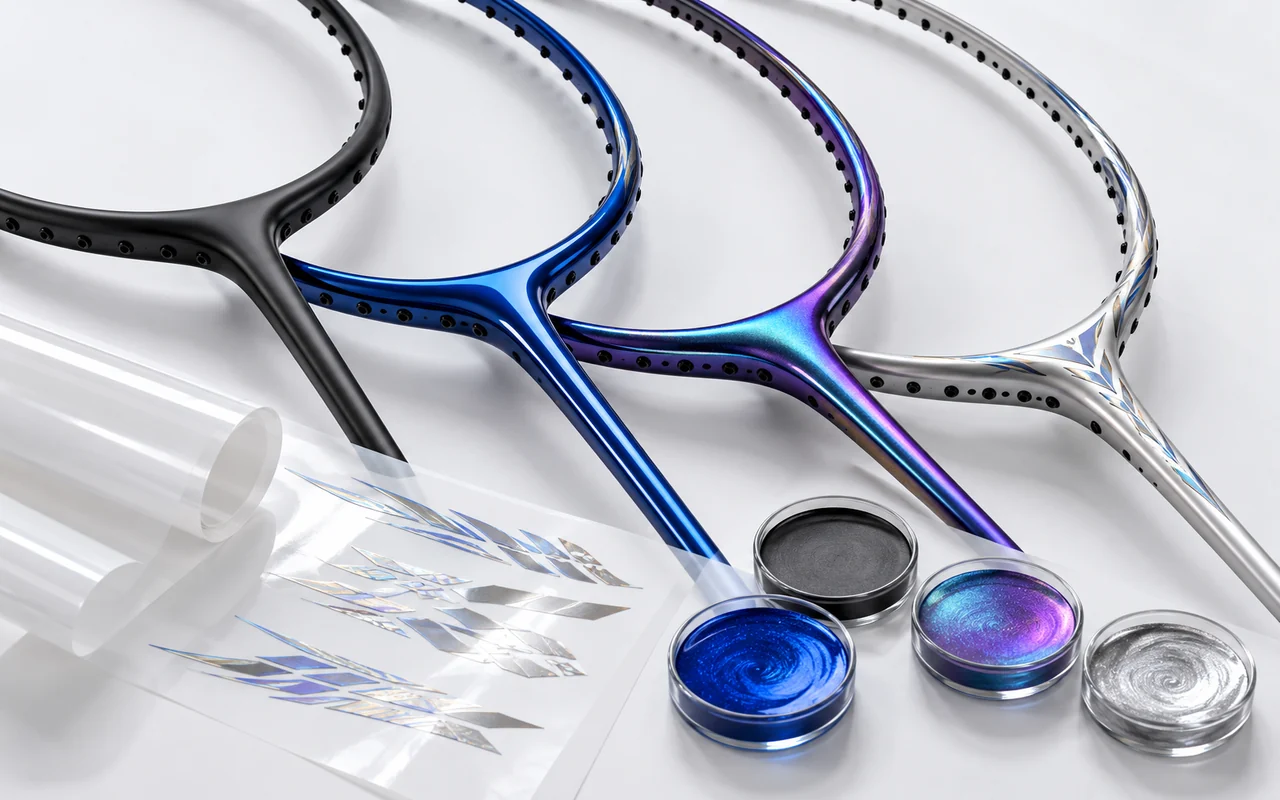
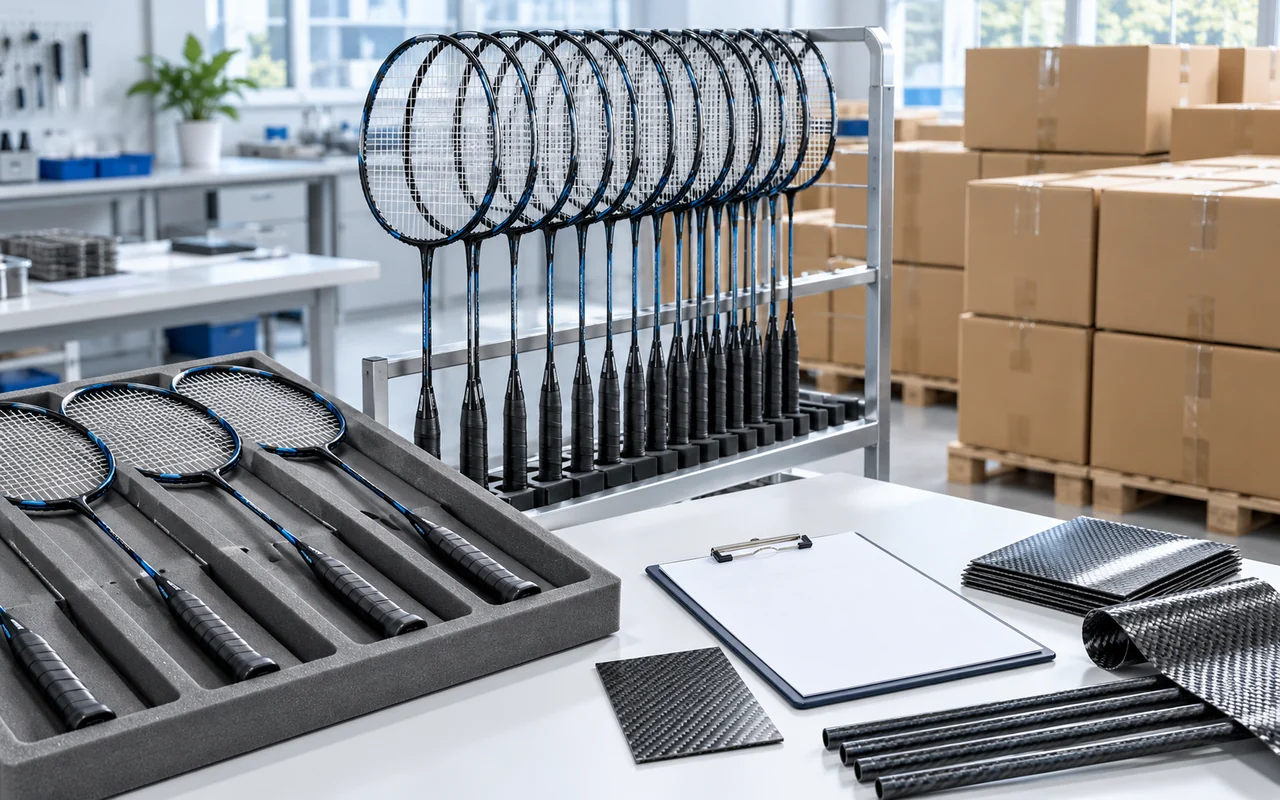
Smart B2B procurement matches material physics to end-user abuse: public school PE tenders, municipal recreation centers, and hypermarket twin-bag sets (50 sets per 0.096–0.13 m³ carton on ST-BD-01, AL-BD-01, and CA-BD-01) deliberately select metallic heads because ductile alloy resists floor-clash fracture far better than rigid high-modulus carbon. Conversely, pro shops, clubs, and tournament brands require 100% Full Carbon (FC-BD-01–04, 200 pcs open-mold private-label MOQ or 50 pcs trial batch). To perform all five QC inspections hands-on with your buying team, order a multi-tier evaluation kit (48–72h stock frame dispatch, 5–7 days custom decals) through our OEM Racket Sample Program and receive full lab inspection datasheets with your parcel.
Multi-Sport Racket OEM Manufacturing Matrix (39 Active Platforms)
Manufactured at our 12,000 m² facility in Fuyang District, Hangzhou (Hangzhou Bailian Trading Co., Ltd., ISO 9001:2015, Est. 2011; 1,200,000+ rackets annual capacity, 100,000+ monthly), our 39 OEM racket platforms span four court sports—Badminton (15 models), Padel (14 models), Tennis (4 models), and Squash (6 models)—engineered across Full Carbon, Carbon Composite, Aluminum Alloy, and Steel constructions.
| Sport Category | Active Models | Material & Layup Systems | Core Physical & Structural Parameters | Representative Model Codes |
|---|---|---|---|---|
| Badminton racket → | 15 | 24T/30T/40T Toray High-Modulus Carbon Prepreg (FC), Carbon Composite (CC), Aluminum Alloy (AL), Steel (ST) | Weight 3U/4U/5U (75g–98g); Balance Point 285–305mm; Shaft Ø 6.8–7.0mm; String Tension 20–35 LBS | FC-BD-01, FC-BD-02, FC-BD-03, CC-BD-01, AL-BD-01, ST-BD-01 |
| Padel racket → | 14 | 3K / 12K / 18K Woven Full Carbon (FC) & Carbon/Fiberglass Composite (CC) + EVA Memory Core | Profile 38mm standard; Weight 360±10g; Length 455mm; Balance Point 260–270mm; EVA Hardness 13°–17° | FC-PD-01, CC-PD-01, CC-PD-02, CC-PD-04, CC-PD-08, CC-PD-13 |
| Tennis racket → | 4 | T700 Full Carbon Monocoque (FC), Carbon Composite (CC), Aluminum Alloy (AL), Steel (ST) | Head Size 96–105 sq.in.; String Pattern 16×19; String Tension 52–62 LBS; Length 685mm (27 in) | UN-TN-01, UN-TN-02, UN-TN-03, UN-TN-04 |
| Squash racket → | 6 | High-Modulus Full Carbon (FC), Carbon Composite (CC), Lightweight Aluminum (AL), Steel (ST) | Head Size 72.5–77.5 sq.in. (500 cm²); String Pattern 14×18 / 16×17 / 16×19; Length 685mm | UN-SQ-01, UN-SQ-02, UN-SQ-03, UN-SQ-04, UN-SQ-05, UN-SQ-06 |
Frequently Asked Sourcing & Engineering Questions
How can I tell if a painted badminton racket is 100% full carbon or carbon-aluminum without damaging it?
Run three non-destructive checks: 1) press the hoop and shaft to your inner wrist at 20°C (an aluminum hoop feels cool for 3–5 seconds due to 205 W/m·K thermal conductivity while full carbon stays neutral); 2) check the 12 o'clock string groove (deep flat-bottomed trapezoid on molded carbon vs. shallow concave arc on rolled aluminum); and 3) weigh the unstrung frame (78–86g for FC-BD-01–04 vs. 90–95g for CA-BD-01).
Are true 100% full-carbon badminton rackets molded as one jointless tube?
No. Although finished full-carbon rackets look seamless, precision OEM manufacturing cures the carbon hoop and mandrel-rolled shaft separately and fuses them internally with a high-modulus Built-In Carbon T-Joint. This architecture delivers superior shaft anti-torsion (≤3.5°) and tighter ±1.5g weight / ±2.0mm balance control compared to jointless tubes or external metal T-pieces.
When should B2B buyers procure AL-BD-01, ST-BD-01, or CA-BD-01 instead of full-carbon rackets?
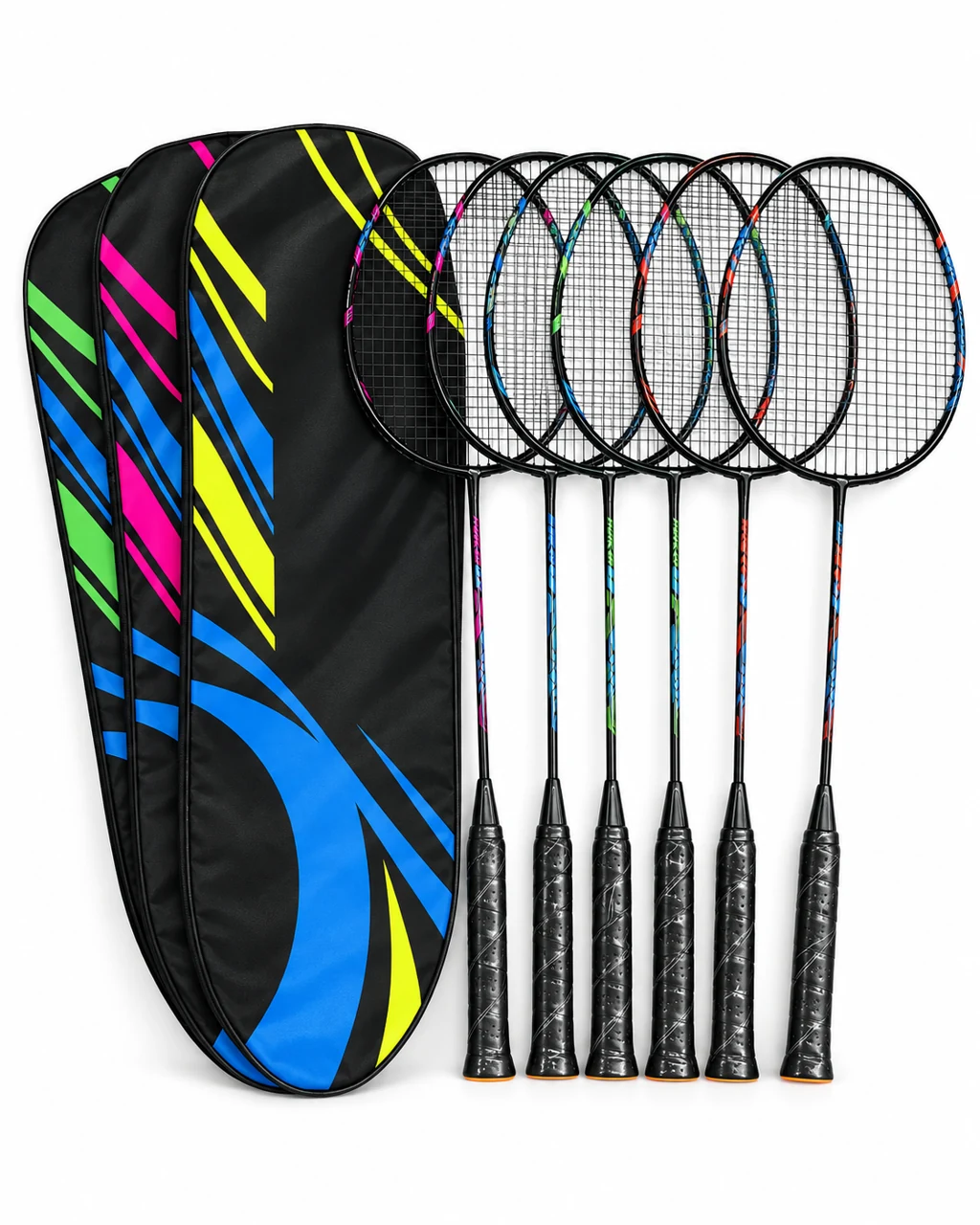
Specify ST-BD-01 (steel), AL-BD-01 (aluminum), or CA-BD-01 (carbon-aluminum, packed 50 twin-sets per 0.096–0.13 m³ export carton) for school PE classes, camp rentals, and mass-retail family twin-packs where frequent gym-floor strikes would crack brittle high-modulus graphite. Specify FC-BD-01–04 for club, tournament, and specialty retail lines requiring 26–30+ LBS stringing.
What is the MOQ and sample lead time for private-label full-carbon vs. alloy badminton rackets?
Unbranded stock structural frames ship within 48–72 hours for lab inspection, while custom Pantone paint and water-decal prototypes take 5–7 days. Open-mold private-label MOQ starts at 200 pcs per model (with 50 pcs trial batches available for initial market validation).