📑 Table of Contents
1. What Does Carbon Fiber Tonnage Actually Mean?
In the composite badminton racket industry, "tonnage" (24T, 30T, 40T) refers to the Young's modulus (tensile elastic modulus) of carbon fiber threads measured in metric tons per square millimeter ((T/mm^2)) or Gigapascals ((GPa)).
Industry Clarification:
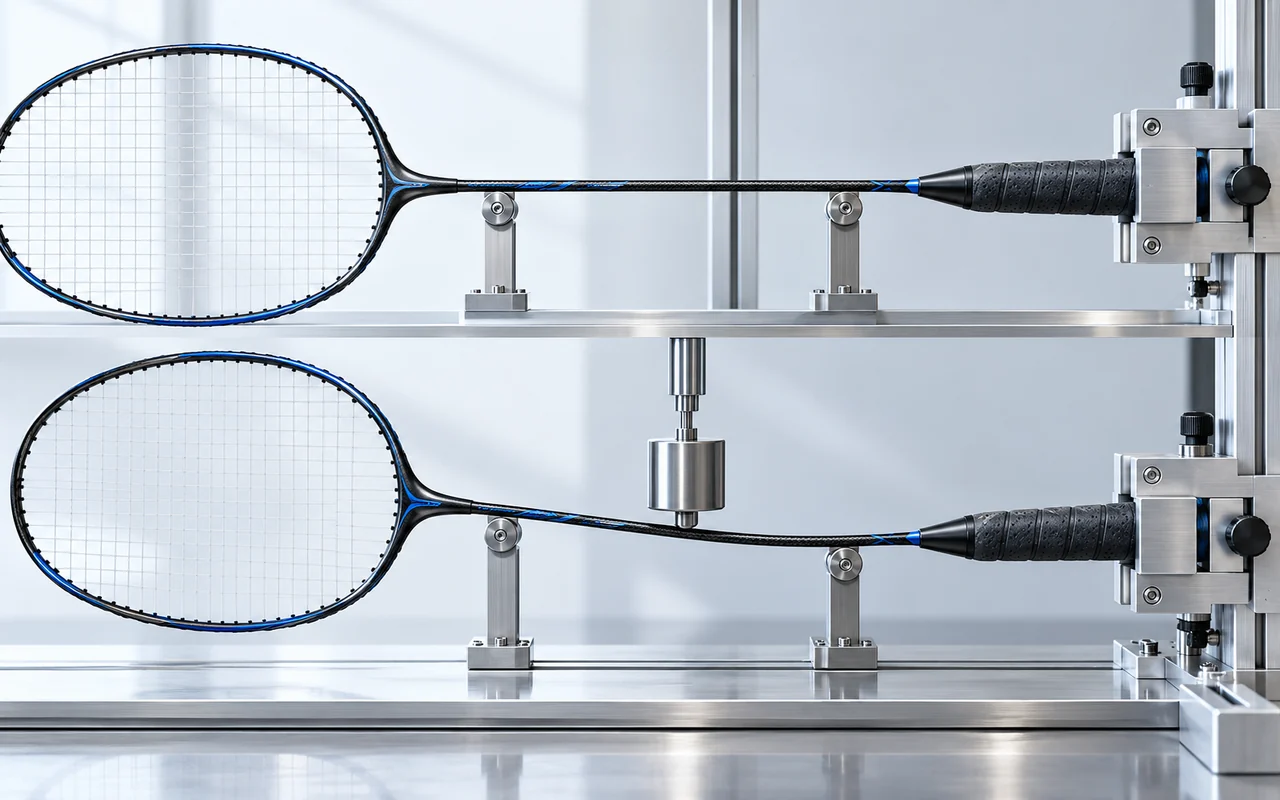
Higher modulus does not mean a stronger racket against collisions. Higher tonnage yields greater flexural rigidity and instantaneous snapback speed, but lower elongation-at-break, meaning pure high-tonnage frames can be brittle without specialized multi-layer layup design.
Most commercial high-end rackets employ imported Japanese Toray prepreg fibers (e.g., T700, T800, M30, M40X) pre-impregnated with toughened epoxy resin under rigorous vacuum and cleanroom conditions.
2. 24T vs 30T vs 40T Mechanical Comparison
Below is the verified mechanical performance matrix across standard carbon fiber prepreg classes utilized on our automated hot-press production lines:
| Modulus Grade | Tensile Modulus (GPa) | Elongation at Break | Toray Equivalent | Best Racket Application |
|---|---|---|---|---|
| 24T (Standard High Modulus) | 230 - 240 GPa | 1.8% - 2.1% | Toray T700SC | Club durable series, junior training frames, handle inserts. |
| 30T (High Modulus Intermediate) | 280 - 300 GPa | 1.5% - 1.7% | Toray T800H / M30SC | Mainstream tournament rackets, 6.8mm slim shafts, 30 LBS support. |
| 40T / M40X (Ultra High Modulus) | 375 - 390 GPa | 1.1% - 1.3% | Toray M40X / M46J | Professional offensive frames, ultra-resilient slim shafts. |
3. Multi-Axial Layup Architecture in Racket Manufacturing
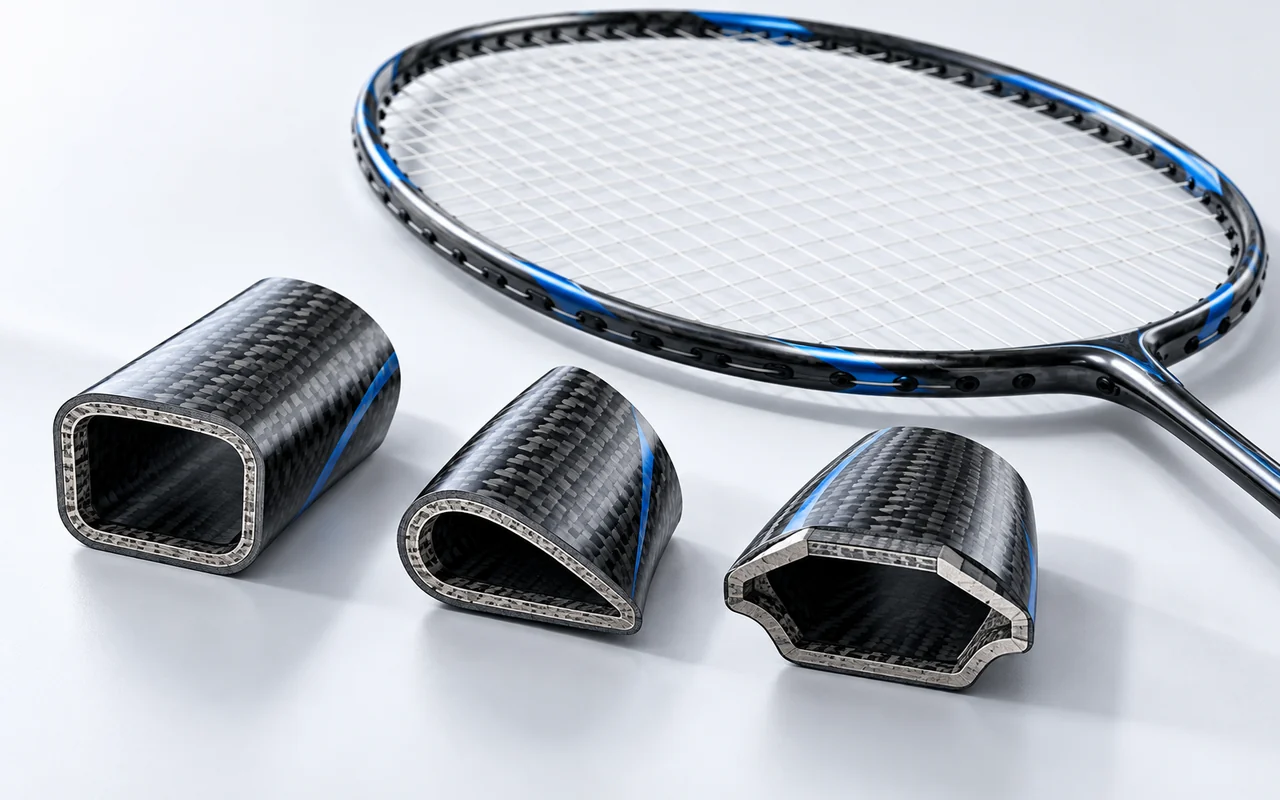
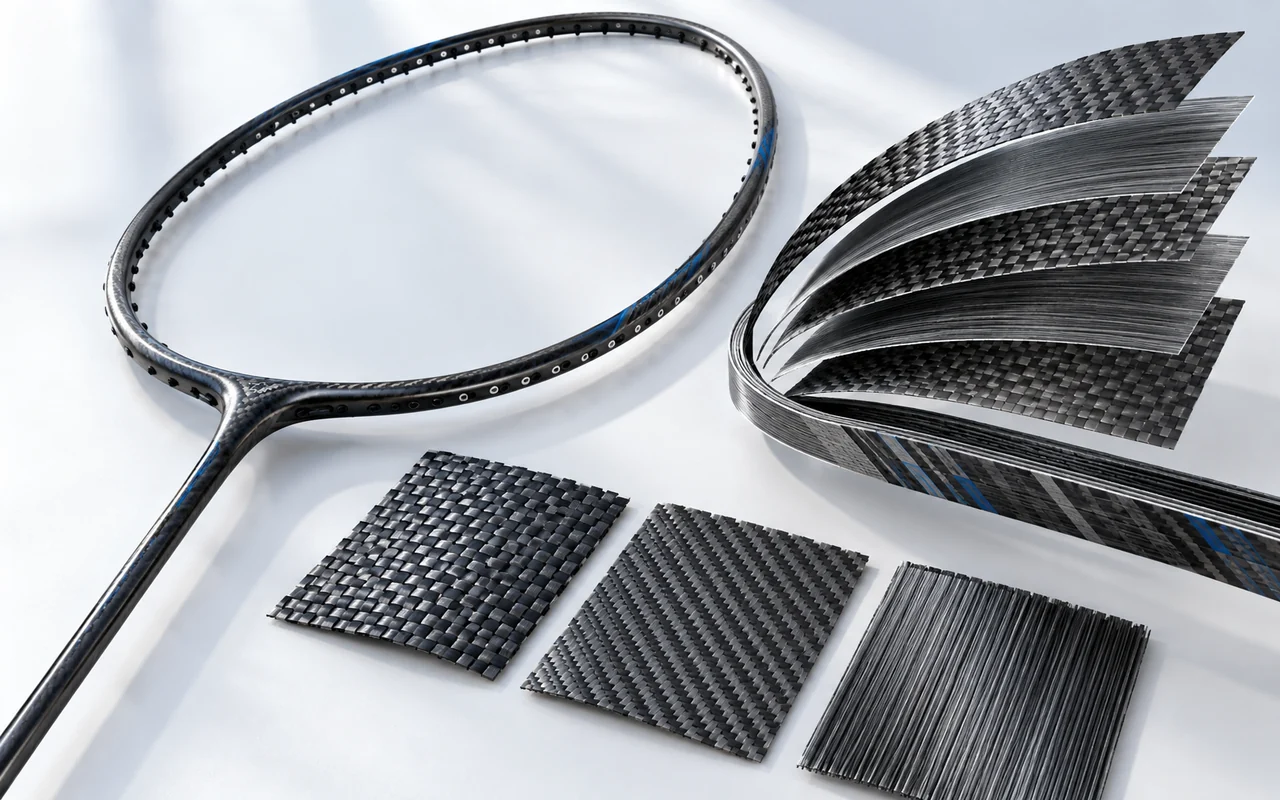
No high-tier tournament racket is crafted from a single carbon fiber layer. In our Hangzhou Fuyang cleanroom manufacturing facility, each racket blank is hand-rolled using a multi-angle ply matrix (0°, ±30°, ±45°, 90°):
- 0° Longitudinal Plies (30T/40T): Provide immediate flex restoration along the shaft axis, optimizing energy transfer during smash follow-through.
- ±45° Diagonal Plies (24T/30T): Crucial for torsional stability (anti-twist rigidity), ensuring the frame does not deviate when contacting off-center shuttlecocks.
- 90° Hoop Plies: Resist internal bladder expansion pressure during autoclave curing and prevent frame collapse at 30+ LBS string tension.
4. Epoxy Resin Systems & Nano-Toughening
The carbon prepreg is bound by thermosetting epoxy resin. To mitigate the natural brittleness of 40T high-modulus carbon, we infuse carbon nanotubes (CNT) and elastomer nano-silica beads into the resin matrix. This increases interlaminar shear strength by over 28% and absorbs high-frequency vibrations before they reach the player's elbow.
5. Sourcing Recommendations for OEM Brands
When launching your private-label racket line, we recommend a balanced 3-tier catalog:
- Entry Tier (Wholesale & Clubs): Full 24T Carbon Composite, 24–28 LBS max tension, forgiving flex profile.
- Flagship Commercial (Retail & Amazon Sellers): 30T High Modulus with 40T localized reinforcement at the 3/9 o'clock frame positions, 28–32 LBS max tension.
- Pro Athlete Series: Toray 40T + M40X nano-composite shaft with 6.8mm outer diameter, calibrated swing weight, and 30–35 LBS string capability.
Multi-Sport Racket OEM Manufacturing Matrix (39 Active Platforms)
Manufactured at our 12,000 m² Hangzhou Fuyang facility (Hangzhou Bailian Trading Co., Ltd.), our 39 OEM racket platforms span four court sports—Badminton (15 models), Padel (14 models), Tennis (4 models), and Squash (6 models)—engineered across Full Carbon, Carbon Composite, Aluminum Alloy, and Steel constructions.
| Sport Category | Active Models | Material & Layup Systems | Core Physical & Structural Parameters | Representative Model Codes |
|---|---|---|---|---|
| Badminton racket | 15 | 24T/30T/40T Toray Full Carbon (FC), Carbon Composite (CC), Aluminum Alloy (AL), Steel (ST) | Weight 3U/4U/5U (75g–98g); Balance 285–305mm; Shaft Ø 6.8–7.0mm; Tension 20–35 LBS | FC-BD-01, FC-BD-02, FC-BD-03, CC-BD-01, AL-BD-01, ST-BD-01 |
| Padel racket | 14 | 3K / 12K / 18K Woven Full Carbon (FC) & Carbon/Fiberglass Composite (CC) + EVA Memory Core | Profile 38mm standard; Weight 360±10g; Length 455mm; Balance 260–270mm; EVA Hardness 13°–17° | FC-PD-01, CC-PD-01, CC-PD-02, CC-PD-04, CC-PD-08, CC-PD-13 |
| Tennis racket | 4 | T700 Full Carbon Monocoque (FC), Carbon Composite (CC), Aluminum Alloy (AL), Steel (ST) | Head Size 96–105 sq.in.; String Pattern 16×19; Tension 52–62 LBS; Length 685mm (27 in) | UN-TN-01, UN-TN-02, UN-TN-03, UN-TN-04 |
| Squash racket | 6 | High-Modulus Full Carbon (FC), Carbon Composite (CC), Lightweight Aluminum (AL), Steel (ST) | Head Size 72.5–77.5 sq.in. (500 cm²); String Pattern 14×18 / 16×17 / 16×19; Length 685mm | UN-SQ-01, UN-SQ-02, UN-SQ-03, UN-SQ-04, UN-SQ-05, UN-SQ-06 |
Frequently Asked Sourcing & Engineering Questions
Does higher carbon tonnage make the racket heavier?
No. Higher tonnage fibers exhibit greater stiffness per unit mass. This allows our engineers to use fewer plies while achieving the same rigidity, resulting in lighter frames (such as 4U 82g or 5U 77g) without compromising structural power.
Can 40T carbon fiber rackets survive racket clashes?
Pure 40T is susceptible to impact fractures. That is why RacketOEM applies hybrid outer wrapping with high-strain 24T/30T carbon armor at the frame perimeter to absorb external impact while keeping the inner core stiff and responsive.