📑 Table of Contents
- →1. 10-Stage Racket Factory Production Matrix: Equipment, Parameters & Defect Control
- →2. Stages 1–4: -18°C Prepreg Conditioning, Multi-Angle Layup & Air-Bladder vs. EVA Molding
- →3. Stages 5–7: Raw Blank Weight Sorting, 5-Axis CNC Drilling & 65°C Water Decal Baking
- →4. Stages 8–10: Laser Handle Alignment, 35 LBS Overload Testing & AQL 1.5/2.5 Audit
1. 10-Stage Racket Factory Production Matrix: Equipment, Parameters & Defect Control
Inside RacketOEM’s 12,000 m² Hangzhou Fuyang manufacturing plant, every tournament-grade carbon fiber racket is built across 10 tightly controlled physical workshops—transforming 18–24 individual Toray carbon prepreg plies into a seamless high-tension frame cured at 145°C–165°C. Unlike commercial lead-time schedules, this engineering walkthrough audits the actual floor machinery, epoxy curing pressures, CNC drilling angles, and batch inspection tolerances governing badminton, tennis, squash, and Padel racket production.
Key Factory Production Takeaways for B2B Buyers & Auditors:
- Cold-Chain Prepreg & Multi-Axis Layup (18–24 Plies): Toray 24T/30T/40T epoxy prepreg is stored at -18°C to prevent premature resin cross-linking, then ultrasonic-cut at 0°, ±45°, and 90° fiber angles to lock in bending stiffness and ≤3.2°–10° shaft anti-torsion.
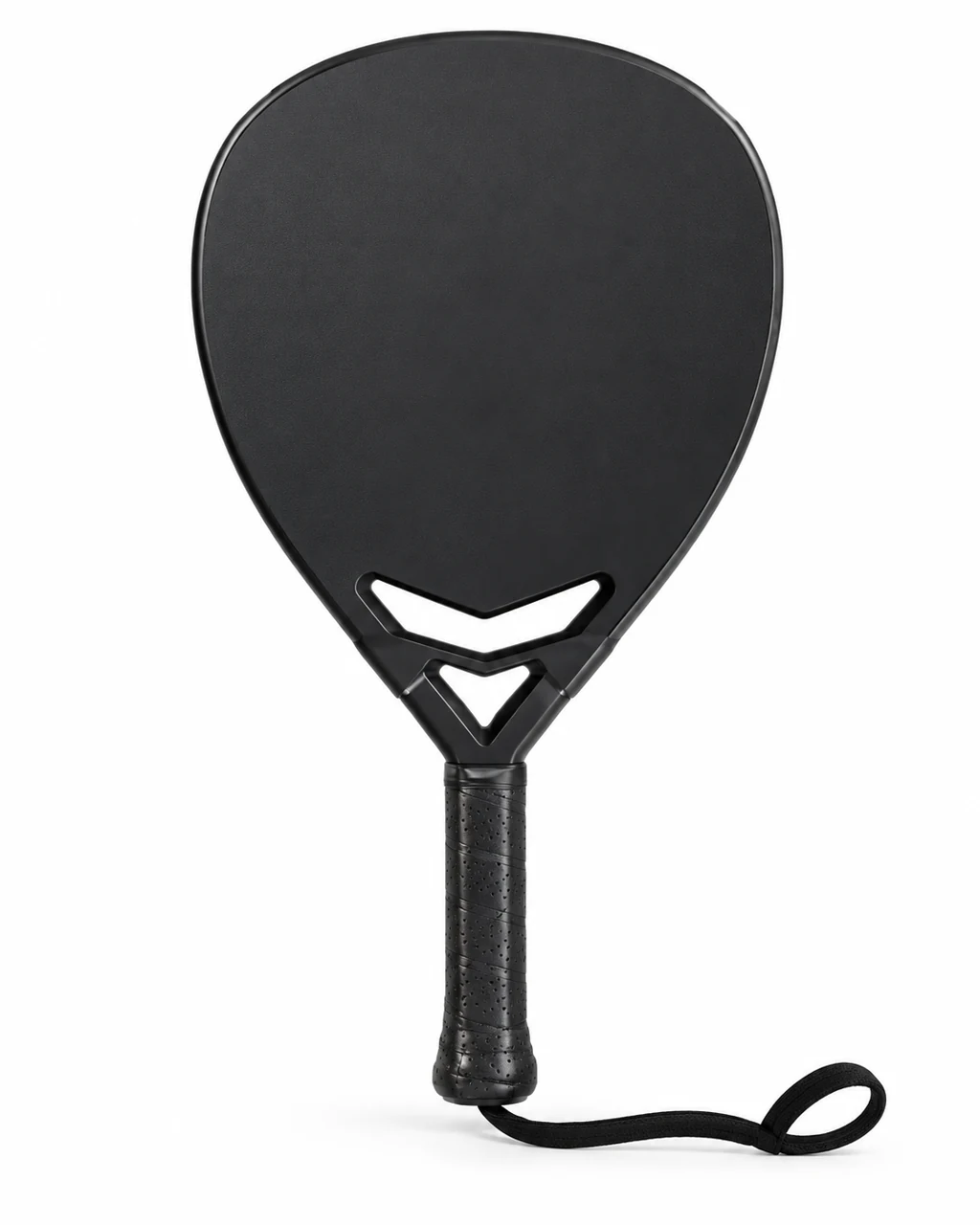
- Internal Air-Bladder (8–12 kg/cm²) vs. EVA Co-Molding: Hollow badminton, tennis, and squash frames expand a nylon bladder at 8–12 bar inside 145°C–165°C steel molds for 28 minutes, whereas Padel rackets (FC-PD-01, CC-PD-01–13) co-mold 3K/12K/18K carbon skins directly onto a 38–45 Shore C EVA core.
- Pre-Paint Blank Sorting & 5-Axis CNC Drilling: Raw carbon frames are sorted within ±1.5g weight and ±2.0mm balance before 3-coat PU painting and 65°C decal baking add 3.5g–5.5g, while 5-axis CNC spindles drill 72/76/80 angled grommet holes without delaminating fibers.
- Laser Handle Assembly & ISO 2859-1 AQL 1.5/2.5 QC: Handles are laser-aligned to ≤0.5mm axial runout, lot-tested on 35 LBS overload and pneumatic swing-fatigue rigs, and serialized via shaft barcodes prior to container loading.
| Stage # | Workshop Process | Core Factory Equipment | Key Process Parameter | Tolerance / Defect Prevented |
|---|---|---|---|---|
| Stage 01 | Prepreg Cold Storage & Thaw Conditioning | Walk-in -18°C freezer & dehumidified cleanroom | -18°C storage; 4h sealed thaw at 22°C / 45% RH (32%–36% resin) | Prevents premature epoxy B-stage curing & dry fiber voids |
| Stage 02 | Multi-Angle CNC Prepreg Cutting | Automated CNC flatbed ultrasonic blade cutter | 0° axial, ±45° torsional & 90° hoop ply patterns | ±0.2mm cut accuracy; prevents off-axis torque twist |
| Stage 03 | Mandrel Shaft Rolling & Frame Preform Layup | Precision tapered steel mandrels & heated rolling table | 18–24 plies; 6.6–7.0mm shaft OD wrapping + T-joint reinforcement | ≤0.10mm wall eccentricity; eliminates spine inconsistency |
| Stage 04 | Air-Bladder / EVA Core Hot-Press Molding | Multi-daylight hydraulic hot press & P20/H13 steel molds | 8–12 kg/cm² nylon bladder (or EVA core); 145°C–165°C × 28 min | Zero internal delamination; prevents collapse at 28–35 LBS |
| Stage 05 | Deflashing, Ultrasonic Check & Blank Sorting | Pneumatic flash trimmer, digital scale & balance board | Parting-line trim; raw sorting before 3.5–5.5g paint gain | ±1.5g weight & ±2.0mm balance bin grouping |
| Stage 06 | 5-Axis CNC Grommet & Padel Face Drilling | 5-axis servo CNC drilling center with diamond carbide bits | 72 / 76 / 80 compound-angle grommet holes or Padel EVA face grid | ±0.1mm pitch; prevents string shear at 2 & 10 o'clock |
| Stage 07 | Putty Sanding, 3-Coat PU Spray & Decal Baking | Water-curtain spray booth & low-temp tunnel baking oven | Pinhole primer + 3-coat matte/gloss/chameleon PU + 65°C × 45 min decal bake | <0.5mm head flatness; prevents decal edge lifting & orange peel |
| Stage 08 | Laser Handle Bonding & Grommet Installation | Laser coaxial alignment jig & PA66 grommet press | Poplar wood / PU foam / carbon handle epoxy lock + U-grommets | ≤0.5mm shaft-to-handle runout; eliminates grip creaking |
| Stage 09 | Constant-Pull Stringing & Grip Wrapping | Electronic microprocessor constant-pull stringing stations | Pre-strung target tension + PU overgrip & heat-shrink film | <1.5% 24h tension loss; prevents hoop ovalization |
| Stage 10 | Overload Fatigue Lab & AQL 1.5/2.5 Final Audit | 35 LBS stress frame rig, pneumatic swing tester & laser coder | ISO 2859-1 AQL 1.5 (Major) / 2.5 (Minor) + barcode lot log | 100% batch traceability; blocks latent structural micro-cracks |
2. Stages 1–4: -18°C Prepreg Conditioning, Multi-Angle Layup & Air-Bladder vs. EVA Molding
Carbon fiber rackets never start as dry woven cloth brushed with liquid glue by hand; professional factories use aerospace-grade unidirectional Toray carbon prepreg pre-impregnated with 32%–36% thermoset epoxy resin. Because epoxy slowly cross-links at room temperature, rolls must remain frozen at -18°C and thaw inside sealed moisture-barrier bags before entering our temperature-controlled layup room. Engineers stack 18–24 custom-shaped plies at exact fiber angles: 0° longitudinal plies carry primary smash bending loads, ±45° bias plies keep torsional twist within ≤3.2° on flagship carbon shafts (and ≤10° across recreational tiers), and 90° hoop plies prevent thin-walled tubes from crushing radially.
For slim shafts (6.6mm–7.0mm outer diameter), technicians wrap angled prepreg sheets tightly around ground alloy-steel mandrels under pneumatic roller pressure, then extract the mandrel after curing. Frame molding diverges by sport architecture: hollow frames for badminton, tennis, and squash use high-pressure internal nylon air-bladder molding (8–12 bar / 8–12 kg/cm²), whereas solid-bodied Padel rackets (such as FC-PD-01 and CC-PD-01–13) co-mold 3K, 12K, or 18K woven carbon face sheets and a tubular carbon perimeter directly around a CNC-profiled 38–45 Shore C EVA foam core.
- Step 1 — Preform Layup & Internal Nylon Bladder Threading: Technicians thread a heat-resistant PA66 nylon air bladder through the rolled carbon hoop strips and insert reinforced carbon wedges + bladder branches into the T-joint throat cavity so shaft and head cure as a single monocoque structure.
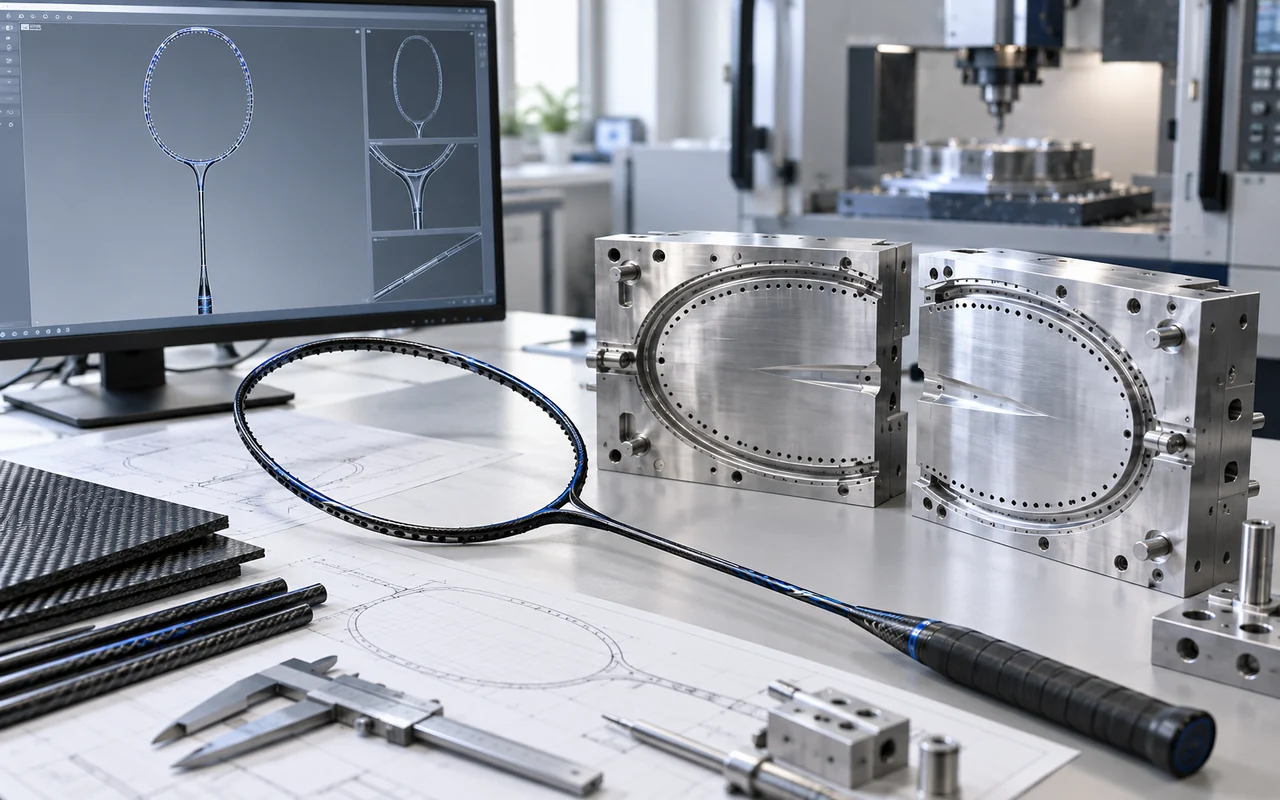
- Step 2 — CNC Steel Mold Clamping & 8–12 Bar Internal Inflation: Hydraulic platens clamp the upper and lower P20/H13 steel mold halves under 60–100 tons of locking force while compressed air inflates the internal nylon bladder to 8–12 kg/cm², compacting carbon plies tightly against the mirror-polished mold cavity.
- Step 3 — 145°C–165°C Epoxy Gelation & Exothermic Cross-Linking: Over a precisely timed 28-minute thermal cycle at 145°C–165°C, epoxy viscosity first drops to wet out inter-ply boundaries and expel trapped micro-air pockets through mold vents, then cross-links into a rigid glass-transition matrix.
- Step 4 — Pressurized Cooling, Demolding & Mandrel Extraction: Internal bladder pressure is maintained during controlled cooling below Tg to prevent tube warpage or spring-back before operators open the press, pull the steel shaft mandrel, and route the raw carbon frame to trimming.
3. Stages 5–7: Raw Blank Weight Sorting, 5-Axis CNC Drilling & 65°C Water Decal Baking
When a cured frame exits the hot press, thin epoxy resin flash along the mold parting line is trimmed and sanded flush, followed immediately by digital raw-blank sorting. Because multi-coat primer, color paint, water-slide decals, and clear topcoat add 3.5g–5.5g of mass and shift the balance point +4mm to +7mm toward the racket head, our workshop weighs and balances every unpainted blank to ±1.5g and ±2.0mm tolerances first—ensuring finished 3U, 4U, or 5U SKU batches hit exact catalog targets without hidden lead-tape compensation.
- 5-Axis CNC Angled Grommet & Padel Face Drilling: Each hollow frame is clamped into a 5-axis servo CNC fixture that drills 72, 76, or 80 grommet holes at compound entry angles matching main and cross string vectors—preventing sharp carbon edges from shearing strings at the high-tension 2 o'clock and 10 o'clock zones. On Padel models (FC-PD-01, CC-PD-01–13), high-RPM diamond bits drill clean aerodynamic face holes through carbon skins and EVA foam without fraying fibers.
- Micro-Pinhole Putty Filling & Progressive Wet Sanding: Technicians apply lightweight two-component epoxy putty to seal microscopic surface gas pores along the carbon weave, then wet-sand progressively from 400-grit to 1000-grit so zero structural carbon filaments are abraded.
- 3-Coat Electrostatic PU Spraying (Matte, Gloss & Chameleon): Frames pass through water-curtain electrostatic booths applying high-adhesion primer, Pantone-matched base color (including metallic, exposed 3K/woven carbon window, or optical chameleon pigments), and impact-resistant polyurethane (PU) clear coat.
- Water-Slide Decal Placement & 65°C × 45 Min Thermal Baking: Ultra-thin multi-color water-transfer decals carrying brand logos, model specs, and string tension ratings are squeegeed bubble-free onto the frame, baked at 65°C for 45 minutes to evaporate moisture, and sealed permanently beneath the final UV-protective clear coat.
Engineering Process Control — Why Decal Baking Never Exceeds 65°C–70°C:
Over-accelerating paint or decal ovens above 90°C approaches the epoxy resin glass-transition threshold (Tg ≈ 120°C–135°C), releasing residual internal molding stress and warping head flatness beyond 0.8mm. RacketOEM locks tunnel ovens at 65°C × 45 minutes so frames retain <0.5mm planar flatness on granite inspection plates.
4. Stages 8–10: Laser Handle Alignment, 35 LBS Overload Testing & AQL 1.5/2.5 Audit
Stages 8 through 10 convert painted carbon frames into court-ready inventory across full-carbon badminton rackets (FC-BD-01–04), composite and alloy tennis rackets (UN-TN-01–04), squash rackets (UN-SQ-01–06), and Padel lines (FC-PD-01, CC-PD-01–13). At this stage, mechanical concentricity and destructive sampling separate export-grade factory production from uncalibrated workshop assembly.
- Stage 8 — Laser Handle Alignment & Structural Bonding (≤0.5mm Runout): Shafts are mounted on a laser coaxial bench to bond kiln-dried poplar wood handles, molded PU foam handles, or integrated carbon handles using two-part toughened structural epoxy, locking overall length (675mm standard badminton) and ≤0.5mm axial runout before fitting the front cone and butt-cap logo badge.
- Stage 8B — Virgin PA66 Nylon Grommet & U-Strip Seating: Heat-stabilized virgin PA66 nylon single grommets, shared double grommets, and recessed throat U-strips are pressed into every CNC hole, shielding high-modulus carbon walls from localized string cut-through.
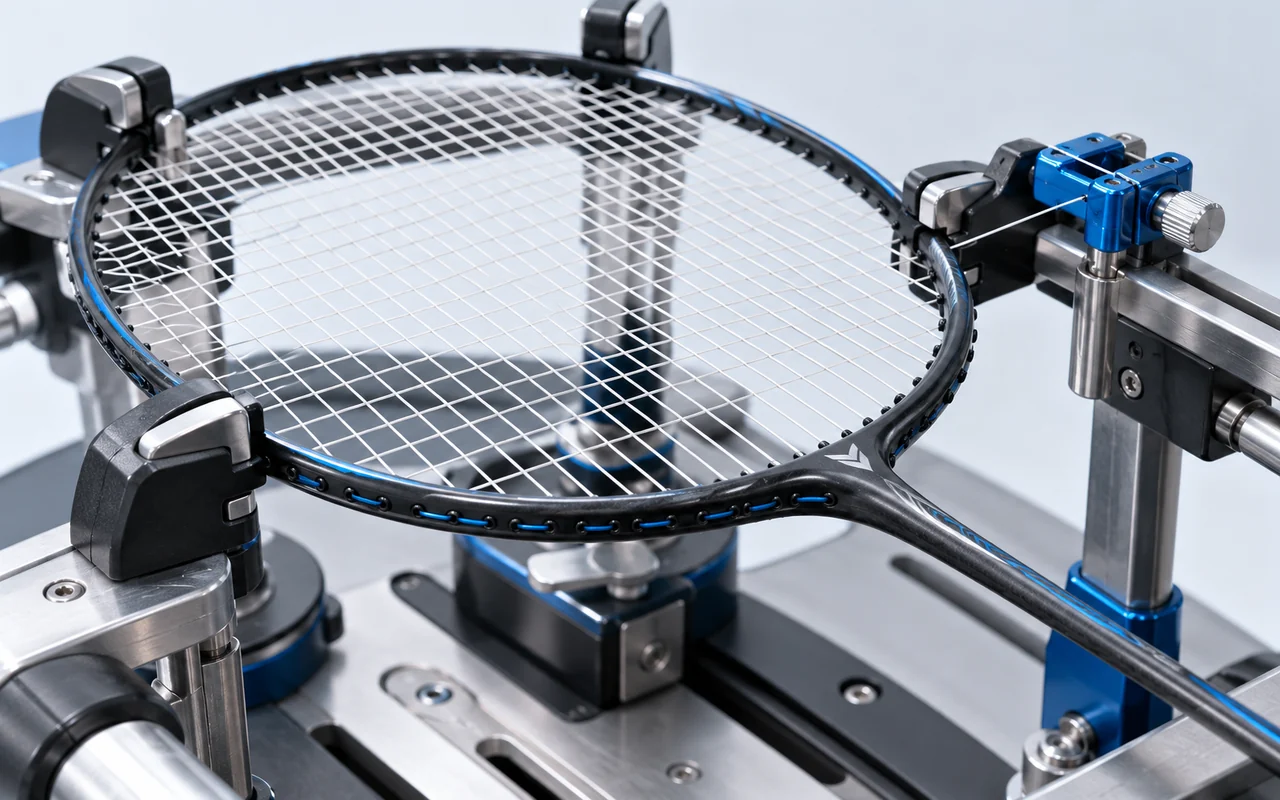
- Stage 9 — Constant-Pull Electronic Stringing & Grip Finishing: For pre-strung OEM orders, microprocessor constant-pull stringing machines tension mains and crosses symmetrically (<1.5% 24-hour tension relaxation), followed by automated PU base grip or tacky overgrip wrapping, heat-shrink handle film, and custom head-card packaging.
- Stage 10 — 35 LBS Overload Stress Rig, Fatigue Testing & AQL 1.5/2.5 Audit: Before carton sealing, QC engineers pull batch samples from FC-BD-01–04, UN-TN-01–04, and UN-SQ-01–06 for 35 LBS overload frame testing, 10,000-cycle pneumatic swing fatigue checks, 3M cross-hatch paint adhesion tests, and laser shaft serial logging under ISO 2859-1 AQL 1.5 (Major) / 2.5 (Minor).
Multi-Sport Racket OEM Manufacturing Matrix (39 Active Platforms)
Manufactured at our 12,000 m² facility in Fuyang District, Hangzhou (Hangzhou Bailian Trading Co., Ltd., ISO 9001:2015, Est. 2011; 1,200,000+ rackets annual capacity, 100,000+ monthly), our 39 OEM racket platforms span four court sports—Badminton (15 models), Padel (14 models), Tennis (4 models), and Squash (6 models)—engineered across Full Carbon, Carbon Composite, Aluminum Alloy, and Steel constructions.
| Sport Category | Active Models | Material & Layup Systems | Core Physical & Structural Parameters | Representative Model Codes |
|---|---|---|---|---|
| Badminton racket → | 15 | 24T/30T/40T Toray High-Modulus Carbon Prepreg (FC), Carbon Composite (CC), Aluminum Alloy (AL), Steel (ST) | Weight 3U/4U/5U (75g–98g); Balance Point 285–305mm; Shaft Ø 6.8–7.0mm; String Tension 20–35 LBS | FC-BD-01, FC-BD-02, FC-BD-03, CC-BD-01, AL-BD-01, ST-BD-01 |
| Padel racket → | 14 | 3K / 12K / 18K Woven Full Carbon (FC) & Carbon/Fiberglass Composite (CC) + EVA Memory Core | Profile 38mm standard; Weight 360±10g; Length 455mm; Balance Point 260–270mm; EVA Hardness 13°–17° | FC-PD-01, CC-PD-01, CC-PD-02, CC-PD-04, CC-PD-08, CC-PD-13 |
| Tennis racket → | 4 | T700 Full Carbon Monocoque (FC), Carbon Composite (CC), Aluminum Alloy (AL), Steel (ST) | Head Size 96–105 sq.in.; String Pattern 16×19; String Tension 52–62 LBS; Length 685mm (27 in) | UN-TN-01, UN-TN-02, UN-TN-03, UN-TN-04 |
| Squash racket → | 6 | High-Modulus Full Carbon (FC), Carbon Composite (CC), Lightweight Aluminum (AL), Steel (ST) | Head Size 72.5–77.5 sq.in. (500 cm²); String Pattern 14×18 / 16×17 / 16×19; Length 685mm | UN-SQ-01, UN-SQ-02, UN-SQ-03, UN-SQ-04, UN-SQ-05, UN-SQ-06 |
Frequently Asked Sourcing & Engineering Questions
How many carbon fiber layers are inside one professional racket?
A tournament-grade full-carbon racket contains 18 to 26 precision-cut prepreg plies depending on local stress zones. Typically, 18–22 multi-angle plies form the hollow frame hoop and 6–8 high-modulus rolled plies form the slim shaft, while high-load zones—specifically the T-joint throat and the 2 o'clock, 10 o'clock, 5 o'clock, and 7 o'clock string corners—receive reinforced patches totaling up to 24–26 layers.
How does Padel racket molding (EVA core + 3K/12K/18K face) differ from hollow air-bladder badminton, tennis, and squash molding?
Badminton (FC-BD-01–04), tennis (UN-TN-01–04), and squash (UN-SQ-01–06) frames are hollow tubes cured by inflating an internal nylon air bladder at 8–12 bar against heated steel mold walls. By contrast, Padel rackets (FC-PD-01, CC-PD-01–13) combine a twin-tube carbon perimeter frame with a solid CNC-cut 38–45 Shore C EVA foam core laminated under hot-press compression between 3K, 12K, or 18K woven carbon face sheets, followed by CNC face-hole drilling.
How much weight does primer, paint, water decal, and clear coat add to a raw carbon frame?
Full cosmetic finishing adds 3.5g to 5.5g of mass and shifts the racket balance point +4mm to +7mm toward the head. Minimalist matte-black or exposed-carbon finishes add roughly 3.5g–4.0g, whereas full-coverage metallic, pearlescent, or chameleon 3-coat PU systems with wrap-around water decals add 4.8g–5.5g—which is why our factory pre-sorts unpainted blanks 4g–5g lighter than the target finished unstrung weight.
What factory inspections can B2B buyers request before container shipment?
B2B buyers can specify ISO 2859-1 AQL 1.5 (Major) / 2.5 (Minor) pre-shipment audits alongside live video or third-party SGS/TÜV witness testing at our Hangzhou Fuyang lab. Standard sign-off packages include digital weight and balance distribution sheets, 35 LBS frame overload stringing verification, 0.5 N·m shaft torsion angle readouts, 3M cross-hatch paint adhesion checks, and barcode batch traceability records.